


Views: 0 Author: Site Editor Publish Time: 2026-11-17 Origin: Site


Sourcing drinkware at scale is not just about approving a pretty digital render. You are translating a design concept into physical pieces that must survive daily abuse in consumer kitchens. Ordering custom ceramic drinkware in volume represents a massive capital risk. Opting for intricate relief textures introduces mechanical and chemical variables that standard flatware never encounters. We are talking about unequal thermal cooling, glaze pooling in deep crevices, and localized stress points around sculptural details. Without strict factory-floor verification, brands easily end up saddled with rough drinking rims, fragile handles, or glazes that fail customs toxicity tests.
Recent shifts across consumer retail show a massive spike in demand for tactile, artisanal-inspired drinkware. Flat, printed graphics are losing ground. Shoppers want sensory appeal and heirloom durability. However, this trend carries a hidden compliance trap. Regulatory authorities across North America and the European Union have drastically increased chemical spot-checks on imported stoneware. Complex textured glazes are prime targets for heavy metal testing. Balancing ornate tactile design with strict safety compliance is now the defining challenge for modern procurement teams. Here is the exact empirical testing framework we use on the kiln floor before authorizing mass production.
Mandate Chemical Safety Verification: Verify compliance against international food-contact laws early. Obtain laboratory documentation proving your batch qualifies as a Non-Toxic Embossed Harvest Animal Cup before the final firing begins.
Scrutinize Relief Depth and Edge Radii: Relief artwork must stay crisp throughout bisque and gloss firings. The surface must remain completely devoid of sharp flashing or glaze-choked details.
Audit Glaze Uniformity and Surface Porosity: Scan every batch for crazing, pinholes, and orange-peel textures. Pay special attention to challenging finishes that easily trap debris.
Apply a Standardized Verification Protocol: Systematically test structural integrity, acoustic ring, water absorption, and thermal resistance across random batch pulls.
Lock in Pre-Production Golden Samples: Never greenlight a full factory run solely from digital renderings. An approved physical sample serves as your absolute legal benchmark.
In high-volume retail distribution, one critical flaw carries outsized consequences. If an end consumer drops hot coffee into their lap because a micro-fractured handle snaps at the joint, the liability lands squarely on your brand. It does not fall on the overseas kiln operator. Today's consumer bases are incredibly quick to document peeling coats or stained rims on social media. A single isolated factory defect rapidly snowballs into a widespread reputation crisis.
Beyond brand perception, the economics of bulk manufacturing leave zero room for error. Ceramic production runs on brutal, high-heat schedules. We rely on precision slip casting and hydraulic pressing. The clay undergoes lengthy drying curves before hitting the bisque firings. Finally, hand-dipped or sprayed glazes face high-fire vitrification up to 1280 degrees Celsius. If a systematic formulation error slips through uninspected, discovering it inside a landed container creates an operational nightmare. Mismatched coefficients of thermal expansion between clay and glaze will cause delayed cracking. The associated costs of freight, disposal, and rushed remanufacturing will easily wipe out your entire quarterly inventory margin.
To eliminate subjective opinions during factory inspections, quality controllers must deploy an empirical testing protocol. This standardized framework provides clear pass or fail criteria for random pulls across every master carton pallet.
Inspection Step | Testing Methodology | Acceptable Pass Threshold |
|---|---|---|
Visual Calibration | Inspect under a standardized D65 daylight lamp at 6500K against approved physical control units. | Delta E under 1.0 color variance. Zero visible sagging, color banding, or uneven glaze lines. |
Tactile Surface Review | Run bare fingers over the lip rim, inner bowl, and raised relief areas. | Completely smooth contact zones. Crisp 3D elements without razor edges or abrasive burrs. |
Capacity & Mass Tolerance | Fill to brim with ambient water via graduated cylinder. Weigh bone-dry cups on digital scales. | Volume variance within plus or minus 3 percent. Overall dry weight variance held under 5 percent across samples. |
Handle Axis Alignment | Mount cup against a vertical 90-degree square gauge. Evaluate horizontal ear clearance. | Vertical deviation under 1.5 degrees. Generous clearance for three adult fingers. |
Base Planarity Wobble | Place unglazed foot ring onto certified float glass and depress opposing rims. | Zero rocking motion. The gap between glass and foot ring must not exceed 0.2mm. |
Acoustic Vitrification | Suspend cup loosely by handle and tap middle wall gently with a brass or wood rod. | Bright, lingering musical chime. Dull thuds indicate internal stress fractures or poor vitrification. |
Water Absorption | Boil dry, pre-weighed base fragments in water for 2 hours, then rest in cold water for 20 hours. | Absorption rate below 0.5 percent for high-fired stoneware, or below 0.1 percent for fine porcelain. |
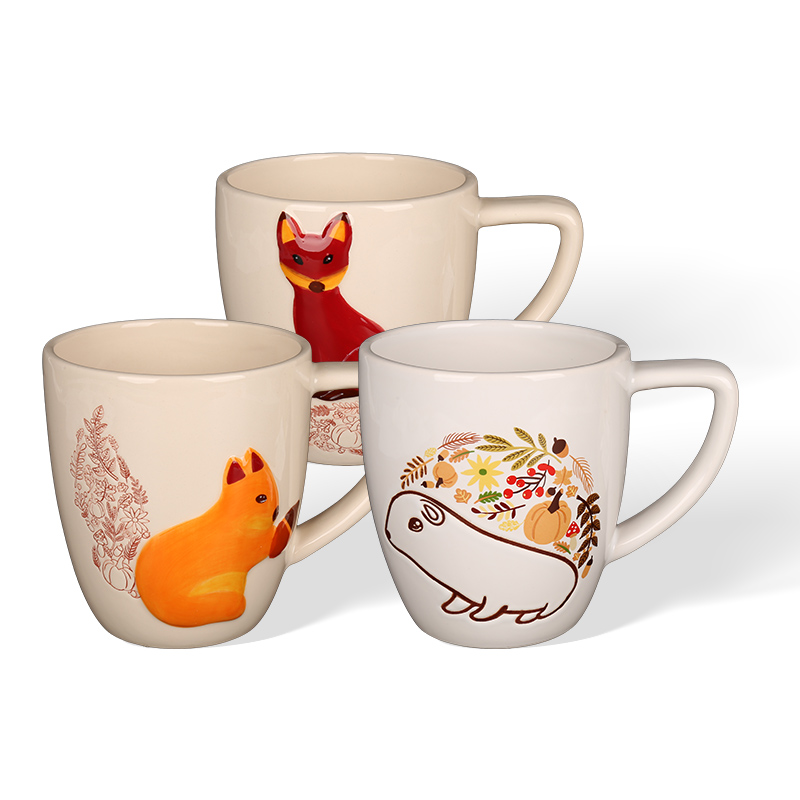
An exquisitely sculpted cup is entirely worthless if it leaches toxins into a customer's morning beverage. Historically, heavy metals like lead and cadmium were popular in commercial kilns. These additives reduced glaze melting points and created brilliant, lustrous reds, yellows, and glossy clears at much lower firing costs. However, acidic beverages like coffee, orange juice, or steeped tea gradually break down unstable chemical bonds in poorly formulated glazes. This chemical reaction allows heavy metals to migrate directly into the liquid.
To eliminate legal liability, your manufacturing specifications must explicitly call for a verified Lead-Free Embossed Harvest Animal Cup certified by third-party testing. For goods entering the United States, strict compliance with FDA Compliance Policy Guides 7117.06 and 7117.07 is mandatory. California Proposition 65 limits are even stricter, often capping leachable lead at less than 0.100 ppm. For the European single market, compliance with Framework Regulation EC No 1935/2004 and the German LFGB standard is non-negotiable.
Never rely on generic factory declarations or expired certificates from previous production batches. Instead, insist on batch-specific test results from accredited testing laboratories such as SGS, Bureau Veritas, or Intertek. The official paperwork must distinctly identify your exact product model number, clay composition, and glaze color formulas.
Engineering a three-dimensional sculpture around a cylindrical vessel requires ruthless precision molding. When liquid clay slip dries and undergoes intense kiln vitrification, the material naturally shrinks. Take our standard 400ml capacity harvest-themed vessels as a baseline. We mandate a strict 8.5cm rim diameter and a 10cm overall height. During the firing process, the clay body will shrink between 10 and 15 percent. If the mold maker fails to calculate these volumetric shrinkage ratios accurately, fine features like animal fur textures or botanical veins will warp. Even worse, the final lid might not fit the rim.
Master plaster molds inevitably degrade over repeated pressing cycles. As the plaster absorbs moisture from damp clay bodies, sharp interior mold details gradually soften into indistinct profiles. To combat this loss of fidelity, procurement teams must establish a mold-retirement ceiling in the supplier agreement. This forces the factory to retire production molds after a set volume of pressings.
Glaze viscosity poses an equal challenge on the production line. Because glaze is essentially molten glass during the peak firing cycle, liquid tension draws it away from sharp high ridges. The liquid then pools inside recessed valleys. An overly viscous suspension will flood delicate carvings, burying subtle details under thick enamel. Inspecting a Cream Embossed Harvest Animal Cup requires checking that the opaque glaze remains evenly spread across ridges without pooling excessively in the negative spaces of the relief.
Glazing serves both decorative and highly functional purposes. It seals the porous clay against bacterial growth while delivering tactile appeal. Inspecting these finishes demands a trained eye for subtle surface defects that emerge only after the kiln cools down.
Inspectors must actively watch for pinholing. These are tiny, needle-like voids formed when trapped air bubbles pop and fail to heal before the glaze solidifies. Another critical defect is crazing. This appears as a spiderweb array of microscopic fissures that develops when the glaze layer contracts faster than the clay body during cooling. Beyond looking flawed, crazed glazes allow coffee tannins, wash water, and bacteria to penetrate the porous core underneath. This creates lingering odors and genuine health hazards.
Specialized matte glazes require separate, rigorous verification protocols. A matte finish achieves its low-sheen look through microscopic crystalline textures that scatter light. However, if improperly formulated, these microscopic structures catch fine metal particles from stirring spoons. To prevent this, quality controllers conduct a practical cutlery marking test. Take a stainless steel spoon, drag it firmly back and forth across the interior and exterior walls, and confirm it leaves no grey pencil-like traces behind. This is especially crucial when evaluating a Matte Embossed Harvest Animal Cup designed for daily cafe use.
Commercial drinkware must withstand real-world abuse. We are talking about boiling water pours, freezer storage, microwave reheating, and high-alkali commercial dishwashers. Standardized physical stress testing separates truly durable drinkware from fragile decorative pieces.
Thermal shock resistance is evaluated by placing the sample cup in an oven heated to 150 degrees Celsius for 30 minutes. We then plunge it instantly into cold water held at 20 degrees Celsius. High-density, fully vitrified clay bodies survive this violent thermal contraction without cracking or surface crazing. If micro-fractures appear, the kiln firing temperature or the cooling rate must be immediately adjusted.
Dishwasher and microwave testing must mirror domestic wear and tear. Dishwasher cycles expose tableware to alkaline detergents at elevated temperatures. After 50 continuous industrial wash cycles, the cup glaze should show no signs of dulling, etching, or fading. For microwave evaluation, the vessel must be run on high power for three minutes while filled with water. A well-formulated ceramic body absorbs negligible energy. The water should boil while the handle stays cool enough to touch safely, proving the core is free of trapped moisture and conductive impurities.
The finest ceramic manufacturing means absolutely nothing if finished goods arrive as shattered shards. Due to their protruding relief profiles, embossed cups are especially vulnerable to transit vibration. When two cups rub against each other under friction, the raised glaze points will scuff, chip, or abrade.
Always mandate International Safe Transit Association drop testing. Specifically, enforce ISTA-1A or 2A protocols. A packed master carton must endure drops from predetermined heights across its corners, edges, and flat surfaces onto solid concrete without breakage. To achieve this survival rate, avoid low-grade bubble pouches. Insist on custom-molded recycled pulp shells or double-wall corrugated dividers that hold each cup firmly in place.
Ocean freight journeys also introduce severe environmental hazards. Extreme temperature swings inside steel shipping containers trigger container rain, where condensation collects on ceilings and drips down onto the cargo. If unprotected, outer shipping boxes soften and collapse under stack pressure. Meanwhile, unglazed foot rings absorb moisture and breed mold. Packing industrial silica gel desiccants alongside poly-lined master cartons keeps contents dry and structurally sound throughout multi-week sea voyages.
Securing consistent quality across thousands of ceramic units requires choosing the right manufacturing partner and locking in clear contractual standards. Look for facilities operating under ISO 9001 certified quality management systems. The best partners maintain their own CNC mold-cutting operations and on-site testing labs.
The pre-production sample is your most vital contractual asset. Never authorize a full production run based solely on digital renderings or factory-supplied stock samples. The physical sample sent for your review must be produced using the exact clay body, glaze batch, and firing schedule planned for your order. Once inspected, stress-tested, and signed off, this physical cup becomes the legal golden sample against which the delivered batch is judged.
Finally, tie your purchase contract to internationally recognized Acceptable Quality Limit standards under the ISO 2859-1 framework. Clearly define defect categories so both parties understand the financial boundaries.
Critical Defects: Zero tolerance. Any safety or health hazard, such as sharp flashing along the rim, heavy metal leaching, or a handle that snaps under normal load, results in immediate rejection of the entire lot.
Major Defects: Functional issues that harm usability or sellability. This includes base wobble over 0.5mm, visible structural crazing, or deep chips.
Minor Defects: Minor cosmetic flaws, such as a microscopic pinhole on the lower foot ring or slight color variance well within acceptable delta ranges.
While visual aesthetics and crisp relief definition drive initial sales, chemical safety verification remains the absolute most critical test. Procurement teams must verify that the glaze and clay formulations pass FDA or LFGB food contact leaching tests for lead and cadmium. Structural durability means nothing if the product poses health risks to consumers.
This loss of detail usually stems from two distinct engineering issues. The first is natural clay shrinkage during drying and firing. The second is overly thick glaze application. Liquid glaze tends to pool inside recessed design lines, softening sharp profiles. Verifying that the factory uses fresh, sharp plaster molds and carefully calibrated glaze viscosity will keep details crisp.
Take an unlacquered stainless steel spoon and press the rounded edge firmly against the glazed surface. Use a back-and-forth scrubbing motion across several passes. Low-quality matte formulations act like fine abrasives, scraping off trace metal particles that leave dark grey scuffs. A properly balanced matte glaze resists this abrasion and wipes clean without staining.
When lightly struck with a hard object, a well-vitrified ceramic piece produces a clear, ringing chime. This indicates that the clay particles melted and fused into a dense, stone-like matrix. A dull thud usually points to hidden structural issues. It reveals internal hairline cracks, poor bonding at the handle joint, or an under-fired piece that remains weak and porous.
Yes, provided the vessel is manufactured using high-fired, fully vitrified stoneware or porcelain. It must also contain no metallic luster pigments like gold or platinum. The piece must achieve a low water absorption rate below 0.5 percent to prevent moisture from heating up inside the walls during microwave use. Trapped moisture causes cracking and makes handles dangerously hot.
Tooling and mold creation usually require two to three weeks of engineering time. Once the golden sample is approved, bulk firing and glazing for a standard commercial order takes an additional thirty to forty-five days. Rushing this high-heat schedule inevitably causes warping or incomplete vitrification.
Most professional procurement teams enforce an Acceptable Quality Limit of 1.5 for major defects and 4.0 for minor cosmetic flaws. Any critical defect regarding food safety or structural failure demands a strict zero tolerance policy, meaning the entire batch is flagged for rejection.
Procuring distinctive, high-relief ceramic drinkware in volume does not have to be a gamble. By establishing objective technical parameters and enforcing systematic batch testing, procurement teams protect their brand equity and bottom line. High-grade stoneware demands disciplined manufacturing oversight from the clay mixing stage to the final kiln cooling. The reward is a tactile, durable product that customers confidently reach for every single morning. If you are looking for a reliable manufacturing partner capable of delivering flawless artisanal designs at scale, explore the full range of compliant, beautifully crafted options at Art-Word to find the perfect match for your retail needs.


