


Views: 0 Author: Site Editor Publish Time: 2026-11-03 Origin: Site


Ordering custom ceramic vessels for retail brands or corporate promotional campaigns demands strict engineering oversight. At the factory level, procurement teams quickly learn that selecting a Pantone glaze color is merely the baseline requirement. A millimeter deviation in physical specifications can trigger cascading failures on the assembly line. Warped logos, vessels that jam commercial espresso dispensers, or handles too cramped for a standard adult grip are common pitfalls. Professional B2B procurement relies heavily on structural integrity data, precise surface calculations, and strict dimensional control to ensure a flawless end-user experience.
Looking closely at recent manufacturing shifts, there is a definitive move toward hyper-functional aesthetics. Modern consumers expect personalized items that interface perfectly with daily utilities. Drinkware must be engineered to clear home brewing nozzles and lock securely into standard vehicle cup holders. Precision is no longer a premium upgrade; it is a strict baseline. With tactile elements and complex geometries dominating the market, procurement teams are adopting a highly rigorous, data-driven approach. Digital mockups must translate flawlessly into physical fired clay, demanding precise surface area calculations and accurate shrinkage projections to prevent costly production bottlenecks.
Capacity Specifications: Clarify brimful volume versus actual usable volume to avoid undersized final products.
Ergonomic Handle Sizing: Internal grip space must accommodate standard adult fingers without causing knuckle burns.
Printable Surface Area: Curvature and height dictate decal scalability without suffering visual distortion.
Wall Thickness Dynamics: Balancing heat retention against dry weight requires careful material selection.
Kiln Shrinkage Margins: Establish written tolerances accounting for the natural contraction of clay during high-heat firing.
When scaling up production, dimensional precision dictates your overall yield rates. Incorrect physical measurements ruin automated screen printing and flat decal applications. If a vessel's curvature deviates slightly from the approved blueprint, decals wrinkle instantly upon application. Screen prints will stretch and misalign. Complex structural designs demand even stricter mathematical modeling. For instance, successfully molding 350ml 3d animal embossed mugs requires precise surface area mapping. If factory engineers fail to calculate the exact protrusion of 3D elements, the shapes warp during the mold release phase or interfere with the drinking lip. Confirming these measurements early ensures aesthetic upgrades never compromise functional safety.
Beyond the physical product, a cup's footprint directly dictates your overarching logistics budget. The maximum horizontal width, including the furthest edge of the handle, determines the exact dimensions of your retail gift boxes. An unexpected expansion of just a few millimeters means the unit will fail to fit into pre-ordered packaging. Repacking delays are notoriously expensive. Furthermore, miscalculated overall heights inflate freight costs. Shipping logistics rely entirely on standardized pallet configurations. If custom boxes run larger than anticipated, cargo density drops. This mathematically increases the landed cost per unit before the inventory even reaches your warehouse floor.
Design Category | Typical Wall Thickness | Shrinkage Tolerance | Key Engineering Challenge |
|---|---|---|---|
Standard Cylindrical | 2mm - 3mm | +/- 3% | Maintaining perfectly straight walls for automated decal wrapping. |
Geometric Stoneware | 4mm - 6mm | +/- 5% | Preventing structural collapse of sharp angles during high-heat kiln firing. |
3D Embossed Novelty | Variable 3mm - 7mm | +/- 8% | Calculating precise mold release angles to prevent warping of protruding elements. |
The commercial market operates on established capacity tiers like 8oz for espresso and 15oz for large cafe servings. Recently, the mid-range size has dominated the industry sweet spot. It provides ample volume for morning coffee while remaining lightweight for comfortable daily use. This specification proves incredibly versatile for retail campaigns. Specifically, a 350ml Embossed Animal Mug serves as an exceptional promotional standard. It balances eye-catching novelty with practical utility, offering enough canvas for textured artwork while fitting seamlessly into crowded kitchen cabinets.
A frequent point of friction between buyers and overseas factories stems from defining volume. It is critical to distinguish between filling a vessel to the absolute rim versus the functional volume a user safely pours. Factories typically list brimful capacity on technical spec sheets, representing the absolute maximum liquid held before overflowing. Everyday consumers, however, care entirely about usable capacity, which leaves a safe margin to prevent spills. Always explicitly ask suppliers which metric is quoted to avoid delivering products that feel noticeably undersized in a real-world setting.
The top rim fundamentally alters beverage flow and user experience. A wider opening exposes more surface area, cooling hot liquids faster. In contrast, a narrow rim traps heat and concentrates aromas. Precise top measurements become non-negotiable when integrating custom accessories. Whether pairing the unit with a friction-fit silicone lid or a bamboo coaster, inner and outer rim dimensions must be accurate to a single millimeter. Loose lids create severe scalding hazards, whereas overly tight covers easily chip delicate glazes over time.
Physical stability relies entirely on base width. Tapered designs featuring wide tops and narrow bottoms look elegant but are inherently top-heavy. Wide-bottom structures lower the center of gravity, offering high tip-resistance for busy desktop environments. Procurement teams should actively measure base diameters against overall height. If stackability is a hard requirement for restaurant clients, the base must perfectly interlock with the inner top diameter of the unit positioned below it.
Vertical clearance is a vital yet frequently overlooked metric for users relying on single-serve coffee makers. Standard commercial espresso portafilters and home brewing machines impose strict height limits. If a customized unit stands just half an inch too tall, it simply refuses to fit beneath the brewing nozzle. Always confirm exact millimeter heights using digital calipers and cross-reference them with standard machine clearances ranging between 90mm and 115mm.
Even visually stunning drinkware fails in the retail sector if it causes physical discomfort. You must carefully measure the internal height and width of the handle, known in engineering circles as the D-space. To accommodate an average adult grip comfortably, this internal void should offer a minimum width of 25mm for finger clearance, paired with a height of 60mm to 70mm. This specific allowance permits fingers to rest securely while the thumb stabilizes the top curve. Shallow D-spaces force knuckles against scalding hot ceramic walls.
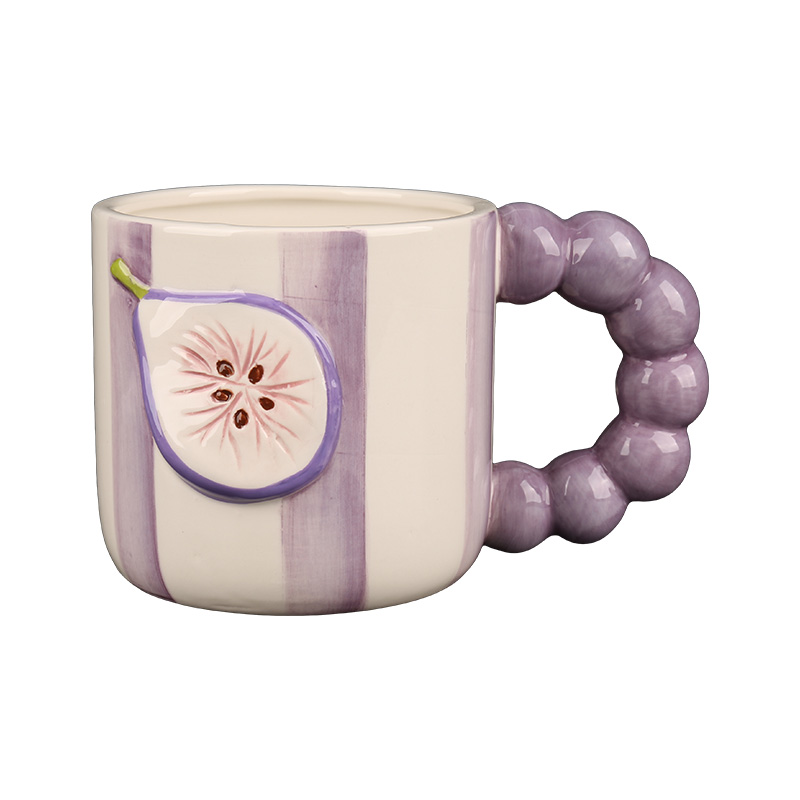
Transitioning from standard C-handles to elaborate novelty shapes makes ergonomic math exponentially more complex. Novelty grips dramatically shift the center of gravity, demanding rigorous structural planning. Consider the engineering behind Fruit Shaped Ergonomic Bubble Handle Ceramic Mugs. These designs feature oversized bulbous handles adding concentrated weight to one side. Such structures require specific thickness metrics and heavily reinforced attachment points. If the attachment footprint is too small relative to the sheer weight, the handle becomes highly susceptible to snapping off during transit or commercial dishwashing.
Determining wall thickness is a strict balancing act between thermodynamic performance and ergonomic comfort. Thicker walls act as superior insulators but exponentially increase dry weight. For a standard mid-sized unit, empty weight should ideally land between 300g and 400g. Confirm these target weights early in the prototyping phase. Units falling below 250g feel overly fragile, while those exceeding 450g become burdensomely heavy once filled, causing rapid wrist fatigue for the end user.
The chosen clay body directly dictates minimum wall thickness. Porcelain and bone china fire at intensely high temperatures, yielding a dense vitrified body molded thinly around 2mm to 3mm while maintaining high tensile strength. Stoneware is inherently more porous and requires a thicker build. Distinct styles like 350ml monochrome geometric stoneware ceramic mugs demand walls typically 4mm to 6mm thick to achieve their signature rustic durability. Attempting to manufacture geometric stoneware with porcelain-thin walls inevitably triggers structural collapse inside the kiln.
Applying branding flawlessly across thousands of units requires exact safe print zone dimensions from the factory floor. Usually formatted as height by width in millimeters, this zone represents the perfectly flat or cylindrical area where automated machines apply ink without distortion. When engineering a wrap-around logo, factor in the physical gap required near the handle. Screen printing machinery cannot physically reach surfaces immediately adjacent to handle joints. A standard non-printable gap of 20mm to 30mm on either side must be integrated into the artwork template.
Printing on non-cylindrical shapes introduces complex geometric hurdles. Tapered surfaces cause standard rectangular logos to warp and curve unprofessionally. You must request a specialized curved artwork die-cut file to ensure logos print straight on slanted angles. For heavily textured products, confirming printable boundaries is equally critical. If the surface is heavily embossed, the factory must provide exact measurements of the designated flat stamp area left intentionally smooth for branding application.
Ceramic mass production is far more organic than metal injection molding. Procurement teams must understand the kiln firing process, specifically noting that natural clay shrinks significantly when baked above 1,200 degrees Celsius. Depending on moisture content and clay composition, ceramics contract by 8 to 12 percent. Consequently, the original plaster mold is always noticeably larger than the final product. Inexperienced buyers often panic when inspecting pre-fired molds. Grasping this shrinkage rate is vital for friction-free communication with factory engineers.
Because shrinkage cannot be controlled to the exact micrometer, B2B buyers must establish acceptable variance margins directly within manufacturing contracts. Enforcing a rigid zero percent variance results in immediate order rejection. Instead, establish clear percentage tolerances. High-quality production runs comfortably agree to tolerances of plus or minus 5 percent on total liquid volume and 2mm to 3mm on physical dimensions. Documenting these margins prevents costly legal disputes upon final container delivery.
Never approve mass production based solely on slick 3D digital renderings. Strongly mandate your procurement team to order a physical pre-production prototype. Once received, use digital calipers to measure height, width, base, and handle clearance, ensuring they perfectly match the signed spec sheet. Physical samples allow for vital real-world scenario testing. Hold the unit to test ergonomics, run it through commercial dishwashers to verify glaze durability, and place it beneath office coffee dispensers to confirm spatial compatibility.
Before wiring the deposit, ensure every physical trait is documented. A comprehensive spec sheet acts as an insurance policy for your capital investment. Use the following engineering checklist to finalize your order:
Target Capacity: Specify Brimful versus Usable in milliliters.
Overall Height: Maximum allowable millimeters.
Top Outer and Inner Diameter: Crucial for accessory integration.
Base Diameter: Verified for desktop stability.
Handle Clearance: D-space height and width in millimeters.
Wall Thickness and Target Weight: Grams and millimeters with defined tolerances.
Safe Print Area: Height by width including handle gaps.
Finalizing a custom ceramic order goes far beyond choosing an attractive glaze. Confirming exact dimensions—from the ergonomic D-space of a bubble handle to the precise printable area for an embossed logo—guarantees structural quality and end-user satisfaction. By deeply understanding material shrinkage, usable capacities, and structural ergonomics, you can execute procurement like a seasoned manufacturing pro. To ensure your next custom drinkware project turns out exactly as engineered, explore precision-crafted options and find the perfect matching products for your brand at Art-Word Custom Ceramics.
Due to the natural shrinkage of clay during the intense kiln firing process, standard industry tolerances are usually set around plus or minus 5 percent for overall liquid capacity and plus or minus 2mm to 3mm for physical height and width.
Not necessarily. Suppliers often measure brimful capacity, meaning the vessel is filled to the absolute top edge. The practical usable capacity for a 350ml unit is typically closer to 300ml to 320ml, preventing spills while walking or stirring.
You must proactively ask your manufacturing engineer for the safe print area dimensions or a specific curved die-cut template. For heavily textured items, the printable area is usually restricted to a dedicated smooth patch on the back or lip.
Base width directly determines physical stability. If you are ordering tall units or designs with heavy oversized handles, a narrow base makes the structure top-heavy and highly prone to tipping over on busy office desks.
You can request a target weight, but because ceramics are organically molded, weight always varies slightly across the production batch. Specifying exact wall thickness is a better metric, as it directly influences the overall weight and premium feel.
Wall thickness acts as the primary thermal insulator. Thicker ceramic walls, typically found in stoneware, trap heat significantly longer than thin-walled porcelain. However, this added thickness substantially increases the dry weight of the vessel, requiring a careful balance for ergonomic comfort.
For an average adult grip, the internal D-space of a handle should measure a minimum of 25mm in width from the cup wall and 60mm to 70mm in height. This specific clearance allows two to three fingers to rest securely without pressing knuckles against the hot ceramic surface.


